
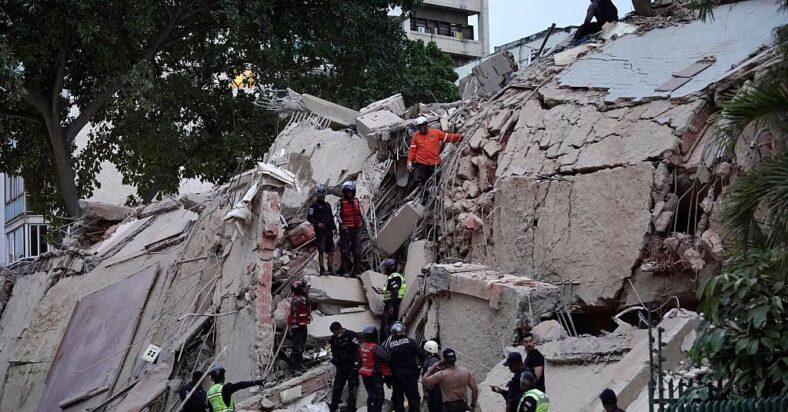
Verónica Cañas barely had time to grab her 6-year-old son and put on her shoes before running out of her apartment in Caracas. As she ran down the stairs, the walls began to crack and part of the facade started to crumble. A few kilometers away in Altamira, 50-year-old Eduardo Burger watched as one building swayed while another fell apart.
Neither of them knew that this was not just a single terrible earthquake but instead a rare phenomenon. On June 24, Venezuela experienced a seismic doublet that saw earthquakes of magnitude 7.2 and 7.5 occur just 39 seconds apart. The first tremor occurred with its epicenter in Yaracuy. Just a few seconds later, an even more intense earthquake shook the same region again.
Both occurred at a shallow depth of between 10 and 20 kilometers (6 and 12 miles), which caused the energy to reach the surface with greater intensity and allowed the seismic waves to be felt as far away as Colombia, northern Brazil, and several Caribbean islands such as Aruba, Bonaire, and Curaçao. While one alone would’ve caused damaged, it was the one-two punch that created the conditions that brought down so many buildings and have made it hard to rescue survivors as the death toll mounts.
The Technical Explanation: Tectonic Plates, Damage, and Resonance
“The dining room table started to shake … We thought it was a tremor; then it started shaking much more violently. The walls were cracking, and pieces of the ceiling were falling. We thought it was going to collapse on top of us,” Cañas says.
She and her family managed to make it to a sports field across from the building, where other neighbors were beginning to gather. There, they were hit by another tremor.
“We all hugged each other, terrified, because we’re not used to this. In Mexico and Chile, there’s an earthquake-preparedness culture, and people are already prepared when an alarm goes off or they feel certain movements, but we aren’t,” she says.
Cañas’ experience highlights one of the main differences between Venezuela and other countries with higher seismic activity. Although the country lies at the boundary between the Caribbean Plate and the South American Plate, earthquakes of this magnitude are relatively rare.
Alan Damián Sánchez Pulido, a civil engineer from Mexico’s Ibero-American University and a specialist in structural damage assessment, explains that the plates’ positions and movements are why earthquakes aren’t as common as they are in other regions—and why they’re so powerful when they do occur.
“In Venezuela, the interaction between the Caribbean and South American plates involves parallel movement; that is what may have caused two earthquakes of considerable magnitude to occur in such quick succession,” he notes.
Unlike Mexico, where the Cocos Plate subducts beneath the North American Plate, in Venezuela, lateral movement leads to different outcomes. “It’s a very rare phenomenon, but the probability isn’t zero. It can occur anywhere in the world where there is interaction between tectonic plates,” Sánchez Pulido says.
What was surprising was not only that two major earthquakes occurred but that the second struck just 39 seconds after the first. To Sánchez Pulido, that short interval is what made this set of quakes so destructive.
“Many structures sustained some kind of damage from the first earthquake. That doesn’t mean the damage was extensive, but any damage alters the original behavior for which they were designed. When another earthquake of similar magnitude strikes immediately afterward, there is no longer any opportunity to reinforce, inspect, or repair the structure. As a result, it no longer performs as intended,” he says.