
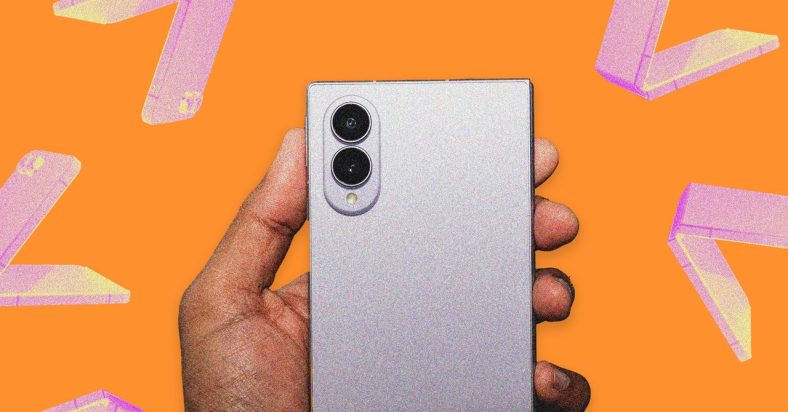
A part of what might also help to make these devices more mainstream is the much talked about crease. Folding phones have an unavoidable crease in the middle where the hinge sits, and many have voiced their disdain for it. Now, thanks to a new titanium display layer that Samsung calls Flex Titanium in the Fold8 and Fold8 Ultra, the crease isn’t as noticeable and feels “flatter” than the more obvious ridge in previous models. Apple has reportedly expended significant effort in trying to eliminate the crease. The lesser the crease, perhaps the more appealing the phone.
Samsung says this titanium plate and the titanium-alloy film also help improve durability. And overall, the phone is easier to open and close, though the Fold8 isn’t designed to sit half-open. Blackard expects most users will stick with the cover screen or inner display, and that “Flex Mode” behavior—with the screen open at a 90-degree angle—is something folks using the Fold8 Ultra or Flip8 are more likely to demonstrate.
Crucially, Samsung also claims the Fold8 is the lightest booklike folding phone on the market, weighing in at a mere 201 grams (32 grams less than the iPhone 17 Pro Max). Weight plays a big role in adoption, as many early folding phones were bulky, heavy, and cumbersome to use. Slimming them down and reducing weight makes them significantly more usable, and the value of having much more screen real estate is easy to appreciate.
Blackard isn’t worried about Apple’s foray into its territory. He says more competition brings visibility to the category—people may know what a folding phone is today, but many haven’t seen or actually used one.
“The more there is out there, the more people will be familiar with the form factor,” he says. “When it comes to their decision, we can rely on the fact that this is our eighth generation. Obviously, first generations tend to go through hiccups.” He also points out that Samsung has a portfolio of devices for consumers to choose from rather than just one.
While others—like Motorola and Huawei—have chipped away at Samsung’s foldable dominance, particularly in the US and China, Samsung’s biggest challenge will be the folding iPhone rumored to arrive as soon as this September. The device could swoop in and take nearly 30 percent of global foldable shipments in 2026, according to IDC forecasts, potentially catapulting Apple as the largest player in the category on the strength of that one device.
The Galaxy Z Fold8 (left), the Galaxy Z Fold8 Ultra (middle), and the Galaxy Z Flip8 (right).
Photograph: Julian Chokkattu