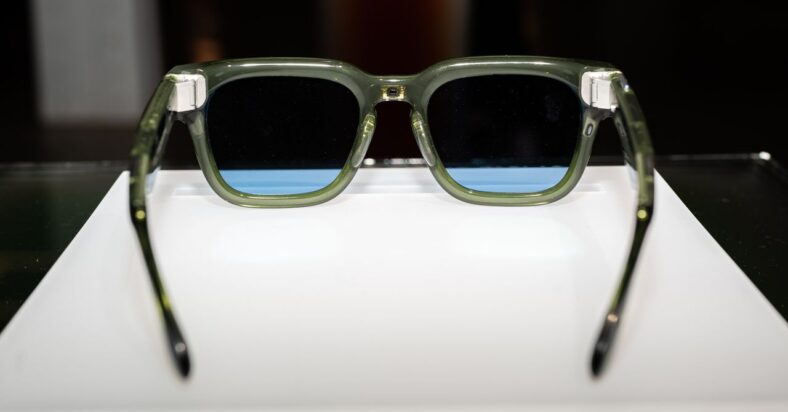
Speaking of, Bosworth says Meta has heard feedback that some folks don’t care for the camera capabilities on its smart glasses and would prefer audio-only glasses. “There’s a market demand for that product for sure.” Bosworth then said, “one thing at a time.”
The Meta Fury.
Photograph: Julian Chokkattu
Earlier this month, WIRED discovered code in the public-facing Meta AI app, suggesting that Meta was gearing up to debut a face recognition feature in its consumer smart glasses, technology that may have been trained by a company that builds surveillance tools for the US military and police departments. After WIRED’s report, Meta deleted the code, and none of this technology is present in the new Meta Glasses. Ankit Brahmbhatt, senior director of Product Management for AI Glasses at Meta, tells WIRED there are “no plans for facial recognition,” as it’s not the focus for what the company is building here.
Meta’s goal with these glasses is to get them onto more faces. “It’s more than just whether they fit—fit and comfort are extremely critical to get right—but it’s also your personal brand,” Bristol says. “It’s a really important decision if we want people to wear them as daily driver glasses.” If more people start wearing these Meta Glasses, that means more people are using Meta AI.
Bristol and Bosworth both lamented that with many of today’s AI tools, you have to supply the context manually, whether by providing a picture, document, or search query. With smart glasses, the AI assistant sees what you’re seeing, and that’s one less burden on your part. “It’s not that the thing isn’t smart enough—sometimes that’s a problem—it’s the amount of work I have to do to get it up to speed,” Bosworth says.
But making smart glasses comfier is just one step. Many people are still concerned about the privacy oversteps made possible by wearable cameras that can discreetly record the user’s surroundings. Bosworth believes such anxieties are akin to what happened when smartphones first put high-quality cameras in our pockets.
“There’s this social norming thing that has to happen,” he says. “The glasses are very popular … that doesn’t mean we aren’t worried about every corner case.”
The new Meta Glasses arrive at a turbulent time for the company’s relationship with its workforce. Bosworth himself sent an internal memo to employees last week promising better communication, stability, and workplace perks to improve morale, which is at an all-time low.