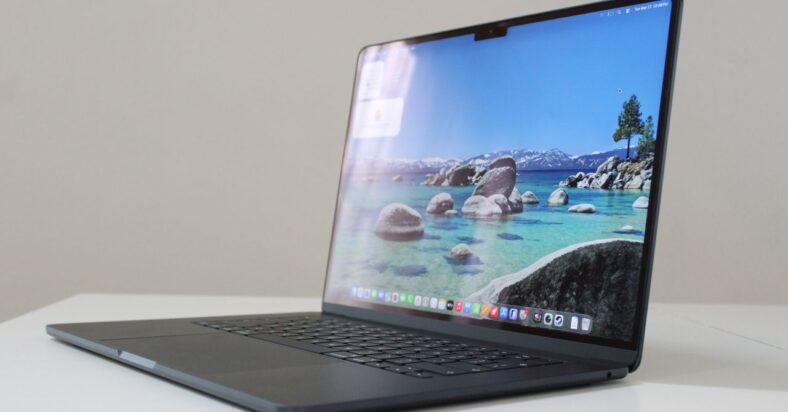
I’ve been reviewing laptops for well over a decade, sometimes testing more than 30 devices per year. They aren’t all winners, and many should be avoided, no matter how slick the marketing or cheap the discount. Good news: It’s my job to recommend laptops that fit your budget and won’t make you regret your purchase six months later. These are my favorite laptops that I’ve tested myself and would highly recommend you buy.
For more guidance, also see my recommendations in specific categories, such as the Best MacBooks, Best Gaming Laptops, Best Chromebooks, Best Budget Laptops, Best Windows Laptops, and Best 2-in-1 Laptops. My guide on How to Choose a Laptop may also help if you’re undecided.
Updated July 2026: I’ve reevaluated the laptop landscape given recent price increases, including Apple’s MacBook lineup. I’ve also included notes from my recent testing of the Dell 14S.
The Laptops I Recommend Most
Apple
MacBook Air (M5, 2026)
When friends or family ask what laptop to buy, I always start with the MacBook Air. It is far more powerful than its compact size suggests. It’s a shame about the recent $200 price increase from $1,099 to $1,299, but even at that new price, it remains my top pick because it nails the big picture. Everything from the trackpad to the speakers are of the highest quality, and it delivers all the performance and battery life the average person needs.
With the latest M5 chip, its GPU matches the M3 Pro MacBook Pro, easily handling everything from gaming to video editing. That’s not at all what the MacBook Air is designed for, but the performance is there when you want to dabble. It’s what makes it feel like a do-it-all machine, all contained in a fanless chassis that’s still one of the thinnest laptops you can buy. Oh, and did I mention it’ll last well over a full work day away from the wall socket and perform just as well on battery as when plugged in? In almost every aspect, it’s the gold standard.
While the lower price of the new MacBook Neo might be tempting, the MacBook Air is the better choice for anyone working at a computer all day. With its superior performance, extra memory, faster storage, and Thunderbolt ports, you will never have to question if you have the right tool for the job. (And unless you already know you need a MacBook Pro, you probably don’t.)
If you prefer Windows or need it for specific applications, the HP OmniBook Ultra 14 is the strongest alternative to the MacBook Air. It might just be the best laptop HP has ever made. The device is beautifully built and incredibly sturdy, with a thin chassis (though the height of the feet makes it taller on the table next to the MacBook Air), an oversized haptic trackpad, and polished metal edges. I also appreciate the three Thunderbolt 4 ports split between both sides for convenient charging, as well as the surprisingly good speakers.
I tested the high-end model, which features a fast Snapdragon X2 Elite, 32 GB of RAM, and a gorgeous 2880 x 1800 OLED display. The screen offers near-perfect colors, excellent brightness, and astounding HDR performance. It doesn’t get much better than this. My only real complaint is that the glossy OLED screen is quite reflective and lacks an anti-glare coating. It’s hoped there will soon be more configuration options, as I’d love to see this higher-end OLED panel available in a cheaper configuration. (The base configuration sold directly from HP has a dimmer, lower resolution screen.)
My other favorite alternative to the 15-inch MacBook Air is the Lenovo IdeaPad Slim 5x. I was impressed by the overall package for this laptop. The price has increased since I reviewed it, up from $900 to $1,150. But compared with the competition, it still rises to the top, primarily thanks to its fantastic 2560 x 1600 OLED display with a 165-Hz refresh rate. I highly recommend spending the $30 to upgrade from the base screen (sold on Amazon) to this excellent OLED version (sold by Lenovo). Additionally, while it is slightly thicker than the MacBook Air, that extra space allows for a great selection of ports, including HDMI, USB-A, and an SD card slot. The Snapdragon X2 Plus isn’t quite an M5 killer, but I was happy with the performance and battery life provided. While I can no longer say it’s the best laptop under $1,000, in a world where laptop pricing keeps increasing, it’s the best value for what you get.
If you are actually shopping for a laptop under $1,000, I’d point you in the direction of the Dell 14 Plus. It came out last year, and in recent months it’s become one of the few Windows laptops worth buying at this price. It has a sharp screen, a decent touchpad, and great battery life. Performance is solid too, using previous-gen Intel chips and 16 GB of RAM. The Dell 14 Plus is exactly that, and it’s currently the best Windows laptop you can buy for less than $1,000.
I used to recommend the Surface Laptop 13.8 (also known as the 7th Edition) as one of my top picks. While I still love this laptop, it’s risen in price dramatically and no longer feels like as good of a value, especially since it’s two years old. The 2024 model now starts at $1,200, while the next-generation model with the Snapdragon X2 chips costs $1,700.
Cheap Laptops That Are Actually Good
While “cheap” means something different to everyone, the best budget laptops generally fall under $750. This is where Windows truly shines, offering great specs for less money. Thanks to the latest processors from Qualcomm and Intel, these laptops now offer battery life that rivals Apple. The best affordable laptop I’ve checked out is the HP OmniBook 5. The model I tested has a Snapdragon X processor, 16 GB of RAM, 512 GB of storage, and a 14-inch OLED screen. Discounts fluctuate frequently, but right now you can buy the 256-GB model directly from HP for $630. That’s a killer deal.
I also recently tested the new HP OmniBook 3, which uses the same chip as the OmniBook 5. It frequently sells for less than the OmniBook 5 by at least a $100 or so. While the OmniBook 3 is a good alternative, the OmniBook 5 is much thinner and looks more modern. Neither laptop has a particularly great touchpad, which is easily the biggest flaw in both laptops. The OmniBook 5 is the better buy if you can afford it, though.
The MacBook Neo is Apple’s new entry-level laptop. It initially started at an aggressive $599, but that price has recently been raised to $699. Even at that price, the laptop shines when it comes to the display. It offers the best screen you can find at this price, bringing the macOS experience to an unprecedented value, even at $699 (or $799 for the 512 GB model). Apple clearly gave priority to the front-of-screen experience, delivering a premium feel across the display, build quality, and keyboard. While the 8 GB of RAM, outdated ports, and slower SSD are notable drawbacks—making the MacBook Air a better choice for remote workers—the Neo is the most premium-feeling laptop available for students, travelers, and casual users.
Given how good some of these budget laptops are, it’s a bit harder to find a place for Chromebooks. The standout option is still the Lenovo Chromebook Plus 14. It’s the most premium Chromebook available, with an OLED screen, 16 GB of RAM, and battery life that rivals the MacBook Neo. Its price just keep going up, though, now up to $849. That’s far too expensive for what you get.
Instead, I recommend the Acer Chromebook Plus 516, which is the best of the cheaper Chromebooks. While it’s a bit thick and the screen isn’t the sharpest (especially for a 16-inch laptop), it’s the best laptop you can buy for under $500, and it occasionally dips down to $349. Acer didn’t skimp on the quality of the touchpad, either, which I appreciate. Windows laptops are about to get much stronger in this category, however, just as higher-priced Chromebooks will be seemingly phased out over time and replaced by the upcoming Googlebooks.
Powerful Laptops for Those Who Need It
Apple
MacBook Pro (M5 Max)
While the laptops above are great for the average person, content creators and gamers need extra performance. For the former, the 16-inch M5 Max MacBook Pro is the ultimate choice. It combines immense power with surprising portability and fantastic battery life—a rare feat. The M5 generation is the most impressive yet, with a greatly expanded GPU and significantly boosted on-device AI processing thanks to a more efficient Neural Engine and faster memory bandwidth. While it is one of the most powerful AI laptops available, the MacBook Pro isn’t for everyone; it is built specifically for professional creatives and engineers running heavy, demanding applications. It’s become more expensive in 2026, but there’s still nothing quite like it on the market.
There are a number of Windows alternatives to the MacBook Pro, including the Asus ProArt P16 and Lenovo Yoga Pro 9i. And while these are both powerful, they take an old-school approach to performance, using hot-and-heavy discrete graphics cards that significantly reduce the battery life to achieve that level of performance. The Dell XPS 14 takes a different approach, ditching the discrete GPU for Intel’s new X9 chip (also known as B390). The results are seriously impressive, replicating the performance of an RTX 4050 without the downsides of using a discrete GPU. Moreover, the Dell XPS 14 has a level of polish in its design really seen only on MacBooks—even surpassing them in some areas.
If you plan on gaming more than a couple of times a week, you will want a dedicated gaming laptop. After testing dozens over the past year, the Lenovo LOQ 15 really stands out. While it is thick and fairly plain-looking, it delivers where it counts. While many budget gaming laptops only feature an entry-level Nvidia RTX 5050 GPU, the LOQ 15 pushes the performance further, delivering well over 60 fps in almost any game at Medium settings—and up to 113 fps in Cyberpunk 2077. That is incredibly impressive for the price. While the current-gen RTX 5050 model is out of stock at the moment, you can still buy last year’s model.
There’s a whole world of gaming laptops outside the budget-tier, though. I’ve tested an assortment of options, and I always come back to the Razer Blade 14 and Razer Blade 16. Portable, minimalist, and extremely well-made, they have rightfully earned their reputation as the MacBooks of PC gaming—along with the MacBook Pro–like price tag. Their sleek design means they work just as well for school or work as they do for gaming, without the bulk of a traditional gaming laptop. While there are more powerful options out there, nothing quite matches the Razer Blade.
Other Good Laptops I’ve Tested
Photograph: Luke Larsen; Getty Lede
If you choose one of the laptops above, you will be very happy with your purchase. However, if you are looking for a specific feature or a different price point, I have included a few other options below. While each of these recently tested laptops has at least one minor drawback, they could still be the perfect choice depending on your needs and currently available discounts.