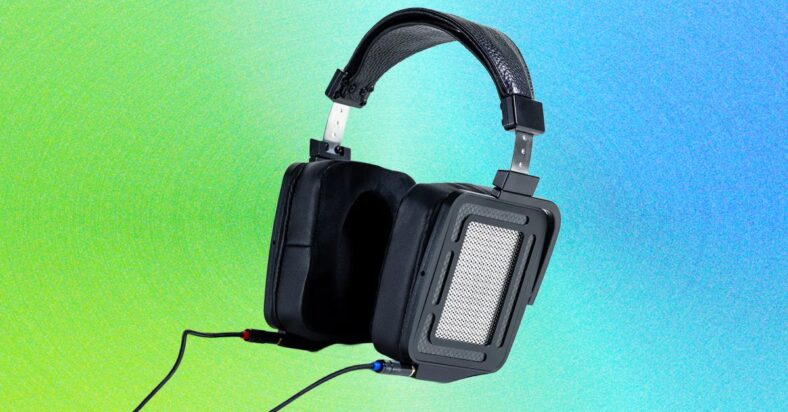
The disparity is relatively subtle—like the difference between a martini that’s stirred (holes in front) as opposed to shaken (holes in the back)—but it’s definitely audible. I tend to prefer headphones with an expansive soundstage and lots of detail. Though with the SJY, I find the slightly warmer and more natural sound more inviting for long listening sessions. And these are headphones that can live comfortably on your head for long stretches.
The impact of the simple switch of earpad orientation is made possible partly because of the design’s arch minimalism. The design was intended to have as few pieces as possible and to hold them rigidly in place with the goal of achieving purity of sound. The aluminum chassis, diaphragm, and driver all measure low, single-digit millimeters. The entire body that clips onto the pads combined is only as thick as a typical monthly magazine in 2026.
Photograph: Martin Cizmar
Because of that, these headphones feel more like a carbon steel pocketknife in the hand than a pair of ANC Bluetooth headphones. They have an impressive sturdiness and don’t feel like something you’ll worry about breaking if you fall asleep with them on. They do weigh more than a pound—at 570 grams with their cable, they’re almost 40 percent heavier than AirPods Max. They come with a padded case that has a generous layer of foam for protection and a braided cable.
Despite their relative heft, I’ve had them perched on my head very consistently since the testers arrived. That’s mainly due to the detailed sound they render from the many gigs of too rarely used 24-bit Hi-Res FLACs on my desktop, as headphones like this can make old songs sound new again. And if it starts to sound old again? Just flip those earpads to have the holes on the other side, and it’s a whole new ballgame.
Curve Killers
The flippable earpads are also made possible by the way they’ve been tuned. High-end wired headphones are having a bit of a renaissance, growing slowly while the rest of the audiophile market dies off around them. But they are also getting more homogenized. That’s because the major makers are aiming to tune their products along the Harman Curve, a guideline for the ideal earphone frequency response built from extensive scientific research, including blind listening.
While the Harman Curve is controversial among enthusiasts on message boards, it’s been widely adopted by headphone makers who strive to get their stock tuning on target. SJY doesn’t reject the Harman Curve but has tweaked the tuning away from it and, even more interestingly, intentionally allows a listener to switch up the signature depending on the orientation of the earpads. That’s what makes them so unique in a world saturated with headphone options. After all, SJY is first and foremost an enthusiast brand, owned and operated by Jeffrey Yin, who started the company in 2020 on the day after his 18th birthday. The SJY line has four models so far, with a fifth on the way, all made by Yin himself in Houston. You don’t buy these to have just another pair of headphones. We hope that’s obvious enough.
But for me, it’s as close to a perfect pair of headphones as I’ve ever owned.
Power up with unlimited access to WIRED. Get best-in-class reporting and exclusive subscriber content that’s too important to ignore. Subscribe Today.